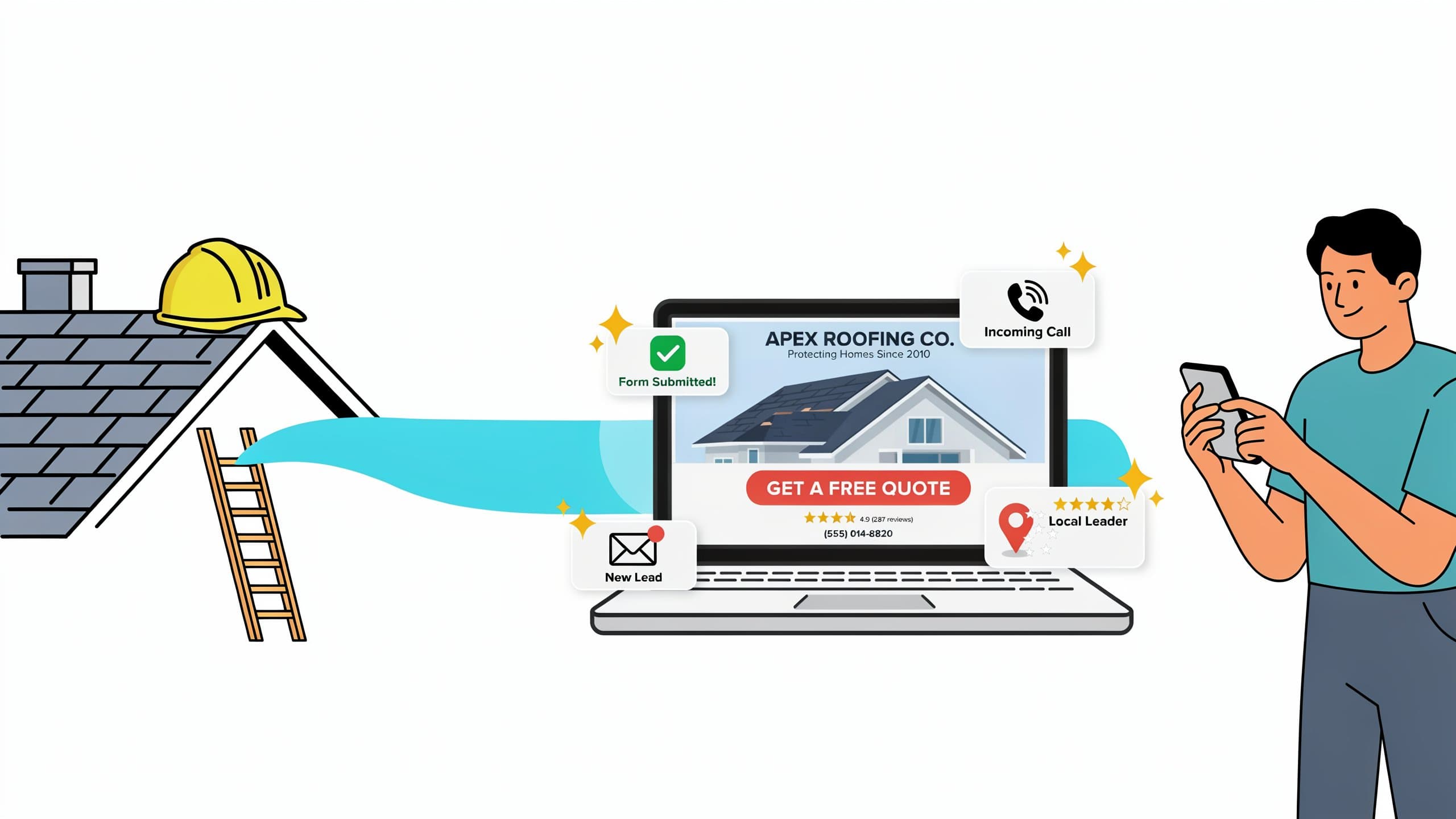
A roofing website has a very specific job. A homeowner finds a leak, notices missing shingles after a storm, or gets a quote that feels too high. They pull out their phone, search, and open two or three roofing websites. Within a few seconds they decide who to call.
Many roofing websites look fine and still fail that moment. The design is nice, the logo is crisp, and the phone rings very little. The gap is almost always practical: slow pages, a hidden phone number, vague proof, or no clear next step.
This guide covers what a roofing company website actually needs to turn visitors into calls and estimate requests. It is written for roofing owners, not developers, so you can use it to review your own site or to brief whoever builds it.
Start With How Homeowners Actually Behave
Understand the visitor before you change the site. A person looking for a roofer usually:
- Searches on a phone, often in a stressful moment such as a leak or storm damage
- Opens several roofers in quick succession and compares them in seconds
- Wants proof that you are real, local, insured, and trusted by neighbors
- Prefers a quick call or a very short form to a long inquiry process
- Often contacts more than one company and tends to respond to whoever replies first
Every decision on your website should help that person act quickly and with confidence.
1. A Fast, Mobile-First Site
Most of your visitors will arrive on a phone, so design for the phone first and the desktop second. Test your own site on your mobile phone, on cellular data and not Wi-Fi.
- Pages should load quickly. Large unoptimized photos and heavy plugins are the usual culprits.
- Text should be readable without zooming, and buttons large enough to tap.
- Nothing should jump around while the page loads.
If your site feels slow to you, it feels worse to a homeowner standing under a leaking ceiling.
2. Click-to-Call and a Clear Next Step on Every Page
Your phone number should be impossible to miss, and on mobile it should be one tap to call. Put it in the header, keep a call button visible as visitors scroll, and repeat it near the end of each page.
Alongside it, offer one simple secondary action, usually a short free-estimate form. Keep the form to the essentials: name, phone, address or ZIP, and a short description of the problem. Every extra field makes people leave.
3. Proof That You Are Legitimate
Roofing is a high-trust, high-cost decision, and homeowners are wary of storm chasers and unreliable contractors. Show your credibility early on the page, not buried in a footer.
- Licenses and insurance. Show your license number where required and state that you are insured.
- Real reviews. Show genuine customer reviews, ideally with names and neighborhoods, and link to your Google profile.
- Real photos. Use photos of your actual crews and completed jobs, not stock images. Before and after galleries are especially persuasive.
- Manufacturer certifications and warranties if you have them, explained in plain language.
- Years in business and local roots. Homeowners prefer someone who will still be around when a warranty claim comes.
4. A Page for Every Service
One page that says "we do roofing" will not help someone searching for a specific need. Give each main service its own page with original, useful content:
- Roof replacement
- Roof repair and leak repair
- Roof inspections
- Storm and hail damage
- Specific materials, such as asphalt shingle, metal, or tile, if you offer them
- Commercial roofing, if that is part of your business
Each page should explain what the service involves, when it makes sense, what the process looks like, and what the homeowner should do next. Write like a helpful expert, not a brochure.
5. A Page for Every Area You Serve
Roofing is a local business, so your site should be local too. Create a page for each city or area you serve, with content that is genuinely specific: the neighborhoods you work in, local conditions such as weather patterns, and examples of work completed nearby.
Avoid copying the same text across city pages and only swapping the town name. That looks thin to both visitors and search engines. A few strong, honest local pages beat dozens of near-duplicates.
6. A Complete Google Business Profile
For many roofers, the Google Business Profile does as much work as the website. Make sure it is claimed and complete, with accurate hours, service areas, categories, photos, and a steady flow of recent reviews. Your name, address, and phone number should match what is on your website.
Link the two together: your website should make it easy to reach your profile and read reviews, and your profile should send people to the right page on your site.
7. Answers to the Questions Homeowners Actually Ask
An FAQ section earns trust and helps with search at the same time. Answer the questions you hear on estimate visits:
- How do I know if I need a repair or a full replacement?
- How long will the job take?
- Do you handle insurance claims?
- What warranty do you offer, and what does it cover?
- Do you offer financing?
- What should I do right after a storm?
Be honest and specific. A homeowner who feels informed by your site is far more likely to call you than a competitor with a glossy page and no answers.
8. Fast Follow-Up Behind the Website
A great website can still lose the job if the lead sits unanswered. Many homeowners contact several roofers at once and go with the one who responds first and sounds helpful. A few simple habits make a large difference:
- Instant confirmation. An automatic message or email that tells the homeowner their request arrived and when to expect a call.
- Missed-call text back. If you cannot pick up, a quick text keeps the lead warm.
- After-hours capture. A form, chat, or assistant that collects the address and problem when the office is closed. If you are curious about the technology side, see our breakdown of what adding AI to a product involves.
- A clear owner for every lead. Someone responsible for calling back the same day.
9. Tracking, So You Know What Works
If you cannot tell where calls and forms come from, you cannot improve. At a minimum, set up:
- Call tracking, or at least a way to log how each caller found you
- Form submission tracking
- Basic analytics showing which pages and sources produce leads
- A simple monthly review of calls, forms, booked estimates, and closed jobs
Focus on leads and booked estimates, not just visits. A site with fewer visitors and more calls is the better site.
Common Mistakes That Cost Roofers Leads
- A phone number that is small, hidden, or not tappable on mobile
- Stock photos of roofs that are not yours
- Slow pages caused by huge images and heavy add-ons
- Long contact forms that ask for too much
- One page that tries to cover every service and every town
- No reviews, or reviews that are old and hard to find
- No plan for answering leads quickly
- An outdated site that has not changed in years
Template, Custom, or Something In Between?
You do not need an expensive custom site to win local leads. A well-built template or a clean website platform is a reasonable choice for many roofing companies. Custom development makes sense when you need features a template cannot offer, such as an estimate request flow tied into your CRM, scheduling, photo uploads, or a tool that qualifies leads before your team calls back. We compare the trade-offs in Next.js vs WordPress if you want the technical side.
Whatever route you take, judge the result by calls and booked estimates, not by how modern it looks.
A Quick Self-Audit You Can Do Today
- Open your site on your phone. How long before you can read it?
- Can you call your company with one tap, from any page?
- Can a stranger see your license, insurance, and reviews in the first screen or two?
- Do you have a page for each main service and each area you serve?
- Is your Google Business Profile complete and consistent with your website?
- If someone submits a form at 7 p.m., what happens next?
Fixing the weakest answer on that list will usually do more than a full redesign.
What We Recommend
Start with the basics: a fast mobile site, a visible phone number, a short estimate form, real proof, and local pages that say something useful. Then make sure every lead gets a quick, human response. That combination wins more jobs than a fancy design ever will.
IXT Minds builds websites, mobile apps, and AI tools, and works with businesses across several countries. If you want a second opinion on your roofing website, or help building one that brings in calls, see how we build websites or talk to us. We will tell you honestly what to fix first, even if the answer is something small.