Almost every founder we talk to in 2026 wants AI in their product. Most of them have a rough idea of what they want it to do. Almost none of them know what it will actually cost — or why two seemingly similar AI features can vary 10× in scope, time, and budget.
That gap between expectation and reality is where projects go sideways. A founder budgets 3 weeks for an "AI chatbot" and ends up 4 months into a RAG pipeline rebuild wondering what happened. Or they spend on a generic SaaS AI tool that can't handle their specific data and produces answers that embarrass the product in front of real users.
This post is the straight-talk breakdown we give every founder before scoping an AI integration — what actually drives the cost, what's consistently underestimated, and how to think about AI as a line item in your product budget.
Why AI Integration Cost Varies So Much
The honest answer: because "AI" describes everything from a single API call to a full machine learning pipeline. The word is doing too much work.
When founders say they want to "add AI" to their product, they usually mean one of several very different things:
- A chatbot that answers questions about their product
- A feature that generates content — copy, summaries, descriptions
- A system that answers questions based on their own documents or data
- A recommendation engine that learns from user behavior
- An automation pipeline that routes, classifies, or processes inputs without human involvement
Each of these has a completely different architecture, timeline, and cost profile. Quoting them the same way is like quoting "a vehicle" — a bicycle and a truck are both vehicles.
The Real Cost Drivers
Before we get to scope tiers, it's worth understanding what actually makes AI integration expensive. It's rarely the model itself.
1. Evaluation and Testing
This is the most underestimated cost in every AI build we've done. Before you can ship an AI feature, you need to know it works — not just that it produces output, but that it produces correct, safe, on-brand output for your specific use case.
That requires building an evaluation framework: a test set of real inputs and expected outputs, automated scoring, and a process for catching regressions when prompts or models change. Skipping this is how products ship AI features that confidently give wrong answers to real users.
Evaluation isn't glamorous and it doesn't show up in demos. But it's the difference between an AI feature you can stand behind and one you quietly pull from the product three weeks after launch.
2. Data Preparation
Most founders want AI that understands their specific domain — their product catalog, their documentation, their support history, their industry terminology. Getting that knowledge into the model requires data work: cleaning, chunking, structuring, embedding, and storing your data in a format the AI can actually use.
If your data is clean and well-structured, this is manageable. If it's scattered across PDFs, WhatsApp exports, Excel sheets, and scanned documents in multiple languages — and this describes most real businesses — data preparation becomes a significant project on its own.
We've worked on builds where the data pipeline took longer than the AI feature itself. It's not unusual.
3. Ongoing Model and Infrastructure Costs
LLM APIs charge per token — every input and output costs money, and it scales with usage. A product with 100 daily active users has a very different ongoing AI cost than one with 10,000. Vector databases, embedding pipelines, and monitoring infrastructure add to this.
Most founders budget for the build and forget to budget for the run. By month 3 post-launch, they're surprised by API bills that weren't in the original plan. Price your product and model your unit economics with ongoing AI costs factored in from day one.
4. Prompt Engineering and Iteration Time
Prompts are not set-and-forget. The instructions that tell an LLM how to behave need to be tested, refined, and updated as your product evolves, as your user base grows, and as the underlying models change. This is developer time — ongoing, not one-time.
A well-built AI feature has version-controlled prompts, a testing process for prompt changes, and someone responsible for monitoring output quality over time. Factor that into your team's capacity planning.
The Three Scope Tiers
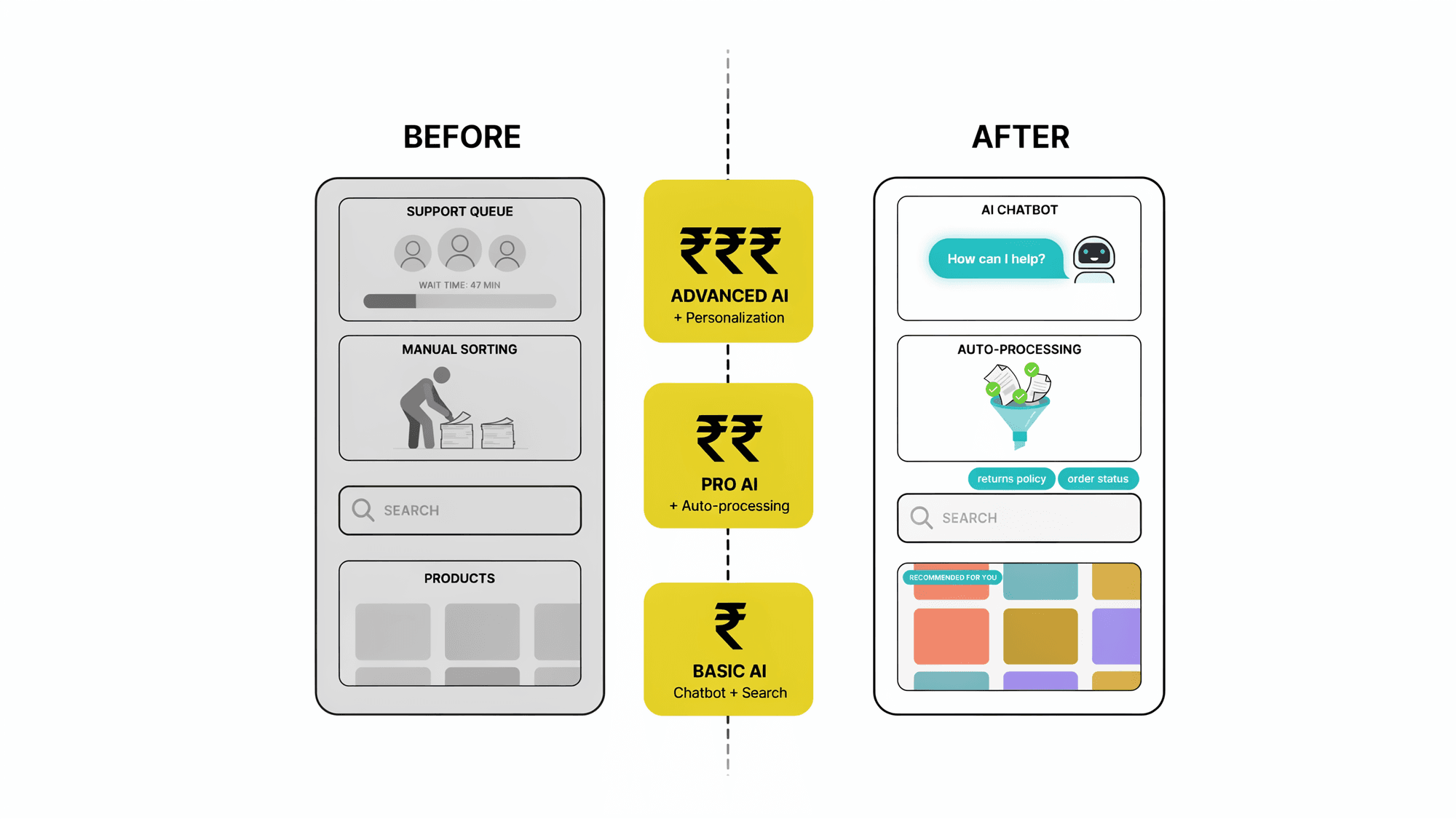
With those cost drivers in mind, here's how we think about AI integration complexity:
Tier 1: API-Powered AI Features
Typical timeline: 2–5 weeks
This is AI integration at its simplest — connecting your product to an LLM API and using prompt engineering to produce useful output. No custom data pipeline, no fine-tuning, no embeddings. Just well-crafted prompts and a clean integration.
What fits here: AI-generated product descriptions, email draft suggestions, basic summarization, simple Q&A on static content, copy generation tools, tone or style rewriting features.
What you get: fast to build, low infrastructure overhead, easy to iterate. Limitations: generic knowledge only (the model doesn't know your specific data), accuracy depends entirely on prompt quality, not suitable for domain-specific or factually critical use cases.
This is the right tier for founders who want to test whether AI adds value to their product before investing in a more complex integration.
Tier 2: RAG-Based AI Systems
Typical timeline: 6–12 weeks
RAG — Retrieval-Augmented Generation — is the architecture that powers most serious AI integrations in products today. Instead of relying on the model's general knowledge, you build a pipeline that retrieves relevant information from your own data and feeds it to the model at query time.
The result: an AI that answers questions based on your actual documentation, your product catalog, your support history, your internal knowledge base — with far better accuracy than prompt engineering alone.
What fits here: customer support bots trained on your actual data, document Q&A systems, internal knowledge assistants, onboarding guides that answer product-specific questions, multilingual support systems.
The complexity drivers: data quality and preparation (how clean and structured is your source data?), retrieval accuracy (does the system find the right information before answering?), evaluation (how do you measure that the answers are correct?), and language complexity (multilingual RAG is significantly harder than single-language).
This is where we do most of our AI work — and where the evaluation and testing investment pays off most clearly. A RAG system without rigorous evals is a liability, not a feature.
Tier 3: Custom AI Pipelines and Model Integration
Typical timeline: 12–24 weeks
This tier covers AI that goes beyond retrieval and generation — classification systems, recommendation engines, demand forecasting, fraud detection, document processing pipelines, and multi-step AI workflows where multiple models or agents work together.
What fits here: automated document processing at scale (extracting structured data from unstructured inputs), AI-powered matching or recommendation systems, multi-agent workflows, fine-tuned models for highly specific domain behavior.
The complexity drivers: data volume and quality requirements are higher, infrastructure is more involved, evaluation is more complex, and the iteration cycle is longer. These builds require a team with real ML and systems engineering experience — not just LLM API integration skills.
Fine-tuning sits in this tier. It's often proposed as a solution when RAG would work better at a fraction of the cost. If an agency is recommending fine-tuning without first ruling out RAG, ask why.
The Question to Ask Before Any AI Scope
Before budget, before timeline, before tech stack — answer this one question:
"What specific problem are we solving, and how will we know if AI solved it?"
If you can't answer the second half of that question — if there's no clear metric, no evaluation criteria, no definition of success — you're not ready to build. You're building hope, not a feature.
The best AI integrations we've shipped started with founders who could say: "Today, users have to do X manually and it takes Y minutes. We want AI to do it in Z seconds with accuracy above N%." That specificity is what makes an AI build scoped, testable, and shippable.
The worst ones started with: "We want to add AI to stay competitive." That's a direction, not a brief.
What to Watch Out For
A few patterns we see consistently in AI integration that go wrong:
- Skipping evaluation to ship faster. You will regret this. AI features without evals ship broken and erode user trust fast.
- Treating AI as a one-time build. AI features require ongoing maintenance — prompt updates, model version management, performance monitoring. Budget for it upfront.
- Fine-tuning when RAG would do. Fine-tuning is expensive, slow, and requires significant data. RAG solves most of the same problems faster and cheaper. Be skeptical of any recommendation to fine-tune without a clear reason why RAG won't work.
- No data strategy before building. If your source data isn't clean, structured, and accessible, your AI feature won't work regardless of how good the model is. Fix the data problem first.
- Generic SaaS AI tools for domain-specific problems. Off-the-shelf AI tools work for generic use cases. The moment your problem requires your specific data, your specific language, or your specific domain accuracy — generic tools will disappoint you.
What We Recommend
If you're adding AI to an existing product, start with the smallest scope that proves the value — a Tier 1 integration that tests whether users actually engage with the AI feature before you invest in a full RAG pipeline. Validate the behavior, measure the impact, then expand.
If you're building AI-native from day one, invest in your evaluation framework before you invest in your model. The teams that ship AI products users trust are the ones that built the testing infrastructure first, not after the first support ticket about a wrong answer.
And in both cases: factor ongoing costs into your unit economics from day one. API bills, infrastructure, and engineering time for AI maintenance are real line items — not something to figure out after launch.
We've built AI integrations across all three tiers — from simple API-powered features to multilingual RAG pipelines on scanned documents in Hindi and English. If you're scoping an AI feature and want an honest read on which tier you're actually in and what it will take to build it right, talk to us. We'll tell you what it needs — even if that means starting smaller than you planned.