Search "app development company in Lucknow" and you will find dozens of options: established software firms, small studios, freelancers who have formed a company, and agencies in other cities that list a Lucknow address. Almost all of them have a clean website and a confident pitch. That makes the choice harder, not easier.
This guide skips the list of names. Instead, it gives you a method you can use on any company, including us. If you apply it properly, you will filter out most of the wrong choices in a week.
One disclosure up front: IXT Minds is an app and software development company based in Gomti Nagar, Lucknow, so we are one of the options you may be considering. Run this checklist on us too. We would rather lose a client to a good process than win one by being vague.
Start With Proof, Not Promises
Every agency says it delivers quality work. Very few can prove it quickly. Ask for evidence that you can verify without trusting anyone's word.
- Live apps you can open. Ask for links to apps in the Play Store or App Store. Download them, use them, and see how they feel. A portfolio of mockups is not the same as shipped products.
- Work similar to yours. A company that has built a marketplace understands marketplace problems. A company that has only built brochure apps will learn on your budget.
- Two client references. Ask to speak to past clients, ideally ones whose projects were not smooth. How a company handles trouble tells you more than how it handles a good week.
- Reviews on neutral platforms. Check Google reviews and platforms such as Clutch, and read the detailed ones rather than the star rating.
If a company will not share any of these, treat that as your answer.
Find Out Who Will Actually Build Your App
This is the question that most buyers forget. The people who join your sales call are often not the people who write your code.
- Who will be the project manager, and how often will you talk to them?
- Are the developers full-time employees, freelancers, or a subcontracted team?
- How senior are they, and have they built this type of product before?
- Will you be able to speak to the developers directly when needed?
Subcontracting is not automatically bad, but you should know about it before you sign, not after.
Check Their Process Before Their Price
A company's process predicts your outcome more reliably than its quote. A good one will walk you through it without being pushed.
- Discovery first. They should ask detailed questions about your users, your goals, and your constraints before quoting anything. If you get a number after a ten-minute call, it is a guess. Our guide to scoping an MVP with 7 questions shows what a proper discovery conversation covers.
- A written scope of work. Features, screens, integrations, and what is not included, all on paper.
- Regular demos. You should see working progress every one to two weeks, not a big reveal at the end.
- Real testing. Ask how they test on actual devices and who is responsible for finding bugs before your users do.
Understand How the Pricing Works
Price comparisons between agencies are only meaningful if the scope is identical, and it rarely is. One quote may include the backend, admin panel, and testing. Another may cover only the screens. Always ask exactly what is included and what would be billed as additional scope.
Be careful with quotes that are far below the others. Low prices are usually achieved by leaving things out, using very junior teams, or planning to recover the margin through change requests later. For a deeper look at what drives the number up or down, read our breakdown of what a mobile app costs in India.
Protect Yourself in the Contract
A good contract protects both sides. Before you sign, make sure these points are written down:
- Scope and timeline with clear milestones
- Milestone-based payments tied to delivered work, never full payment upfront
- Ownership of source code and designs transferred to you on payment
- Your own accounts for the app stores, cloud hosting, and any third-party services, so you are never locked out
- A change-request process that states how new requests are priced and approved
- Confidentiality for your idea and your data
- Post-launch support terms covering what is included, for how long, and at what cost
Ask What Happens After Launch
Launch is the beginning of an app's life, not the end. Real users will find bugs, ask for changes, and push your infrastructure in ways testing never did. Operating systems also change every year, and apps need updates to keep working.
Ask every company: who fixes bugs after launch, how quickly do they respond, what does ongoing support cost, and will the same team that built the app still be available? Companies that disappear after delivery leave you with an app nobody understands. This is the area where we try to differentiate: we stay on after launch, because shipping is the start of the work.
When a Lucknow-Based Team Actually Helps
Location should not be the main reason you choose a company, but it does have real advantages in some cases.
- In-person workshops. Scoping and design sessions are faster when everyone is in the same room with a whiteboard.
- Quick decisions. Walking over for a meeting beats waiting for a call slot, especially during critical weeks.
- Local context. If your product serves Uttar Pradesh or North India, a team that understands local users, languages, and payment habits can save you mistakes.
- Trust and accountability. Many founders simply feel safer working with a team they can visit.
On the other hand, a strong remote team can be the better choice if your product needs specialist skills you cannot find nearby. The right answer is the best team you can verify, and location is the tiebreaker.
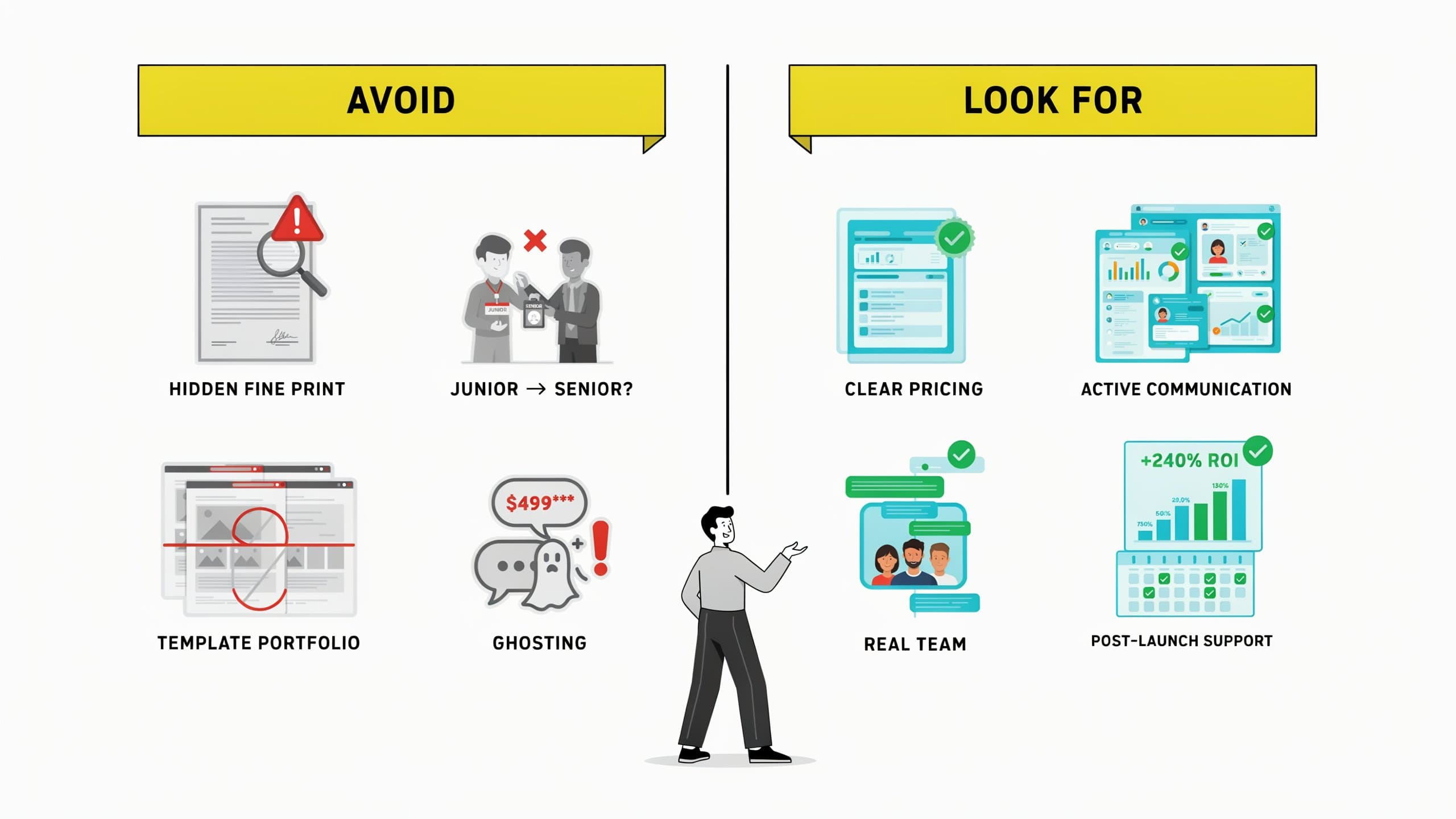
Red Flags to Walk Away From
- A fixed price quoted within minutes, with no questions about your product
- No live apps to show, or portfolio items they cannot explain in detail
- Reluctance to put the scope in writing
- Asking for full payment before any work is delivered
- Keeping control of your source code, store accounts, or hosting
- Promising a full app in a few weeks regardless of what it does
- Pushing a particular technology without explaining why it fits your product
- Vague answers about who will work on your project
A Simple Way to Compare Your Shortlist
Pick three companies, ask each the same questions, and score them on these points:
- Can they show live, relevant, shipped work?
- Did they ask good questions before quoting?
- Is the scope written and specific?
- Do you know exactly who will build it?
- Are the payment and ownership terms fair?
- Is there a clear plan for after launch?
The company that scores best across all six is almost always the right choice, even when it is not the cheapest.
What We Recommend
Do not choose in a single meeting. Take a week, verify the proof, speak to past clients, and compare written scopes. The few days you spend now protect months of work and a significant budget.
IXT Minds builds mobile apps, websites, and AI products from our office in Gomti Nagar, Lucknow, and works with clients across India, the UAE, and Canada. Every project starts with a written scope of work, and we stay on after launch. If you are choosing a development partner, you are welcome to see how we build mobile apps or talk to us. Bring the checklist above and hold us to it.