Every week we get on calls with founders who have great ideas, real budgets, and a clear sense of urgency. And almost every week, we end up steering at least half of them away from what they originally wanted to build.
Not because their ideas are bad. Because their scope is.
The dirty secret of MVP development is that the build is rarely where things go wrong. The scoping is. A founder shows up with a 30-feature wishlist disguised as a "minimum viable product," signs with the cheapest agency, and resurfaces 9 months and ₹35 lakhs later with a half-working product, no users, and no idea what to fix first.
The MVPs that ship in 8–12 weeks and actually find traction aren't built by faster developers. They're scoped better at the start. Here are the 7 questions we ask every founder before we write a single line of code — and what we're actually listening for in their answers.
QUESTION 1
"Who is the single user this product serves on day one?"
Not a segment. Not a persona. A real, specific person.
"Indian SMB owners" isn't a user. "Rajesh, a 38-year-old owner of a 12-employee logistics company in Indore who currently manages dispatch on WhatsApp and Excel" is a user.
The reason this matters: every product decision downstream — UI choices, onboarding flow, pricing, integrations, support model — depends on knowing exactly who you're building for. Founders who can't answer this question end up building products that try to please everyone and resonate with no one.
QUESTION 2
"What is the one workflow your product replaces or improves?"
Most failed MVPs try to do too much. The ones that succeed do one thing dramatically better than whatever the user is doing today.
Today, your user is solving the problem somehow. Maybe with spreadsheets. Maybe with WhatsApp groups. Maybe with three different SaaS tools held together by manual data entry. Whatever it is — your MVP only needs to replace that one workflow, not reinvent their entire operations.
One of our recent clients came in wanting to build a full HR platform: payroll, leave, performance reviews, recruiting, onboarding. We pushed them to launch with just the leave management workflow because that was the daily pain. Their first 200 customers came in within 5 months. The other modules got built — funded by revenue from the first one.
QUESTION 3
"What does the user do on day one of using your product?"
Walk us through the first 5 minutes. From the moment they sign up to the moment they get value.
This is where most founders realize their MVP scope is broken. They've thought deeply about features but haven't thought about activation. The first-use experience is what determines whether someone pays, churns, or refers a friend.
If the answer involves "they fill out a setup wizard, then connect 3 integrations, then import data, then invite teammates, then…" — your MVP is too heavy. Strip everything that isn't required to deliver the core value in the first session.
QUESTION 4
"What would make you abandon this project in 6 months?"
This is the question founders find most uncomfortable. Good. That's the point.
We're not being pessimistic — we're surfacing assumptions. Every founder is implicitly betting on a few things being true: that users will pay, that acquisition will work, that retention will hold, that the technical approach will scale. If any of those assumptions are wrong, the MVP fails.
Naming the failure conditions upfront does two things: it makes you scope the MVP to test those specific assumptions, and it gives you a clear off-ramp if the data says you should pivot. Founders who refuse to name failure conditions often grind on dying products for 18 months because they've never defined what "this isn't working" looks like.
QUESTION 5
"What are you NOT building in v1?"
The list of things you're cutting matters more than the list of things you're building. Every "we'll add that later" is a decision that protects your timeline and budget.
We push founders to write down their explicit "not in v1" list before development starts. Things like:
- Mobile apps (web-only for v1)
- Enterprise SSO (basic auth only)
- Multi-language support (English/Hindi only at launch)
- Advanced analytics dashboards (CSV export is enough)
- White-labeling, custom domains, complex permissions
This list becomes a contract — both with us and with yourself. When scope creep tries to sneak in mid-build (and it always does), this list is what you point to.
QUESTION 6
"How will you get your first 50 paying users?"
This question reveals whether you've scoped a product or scoped a fantasy.
If your distribution plan is "we'll figure it out after we launch" or "we'll run some ads," your MVP is going to die not because of the build, but because you didn't account for the second-hardest part of building a SaaS: getting people to use it.
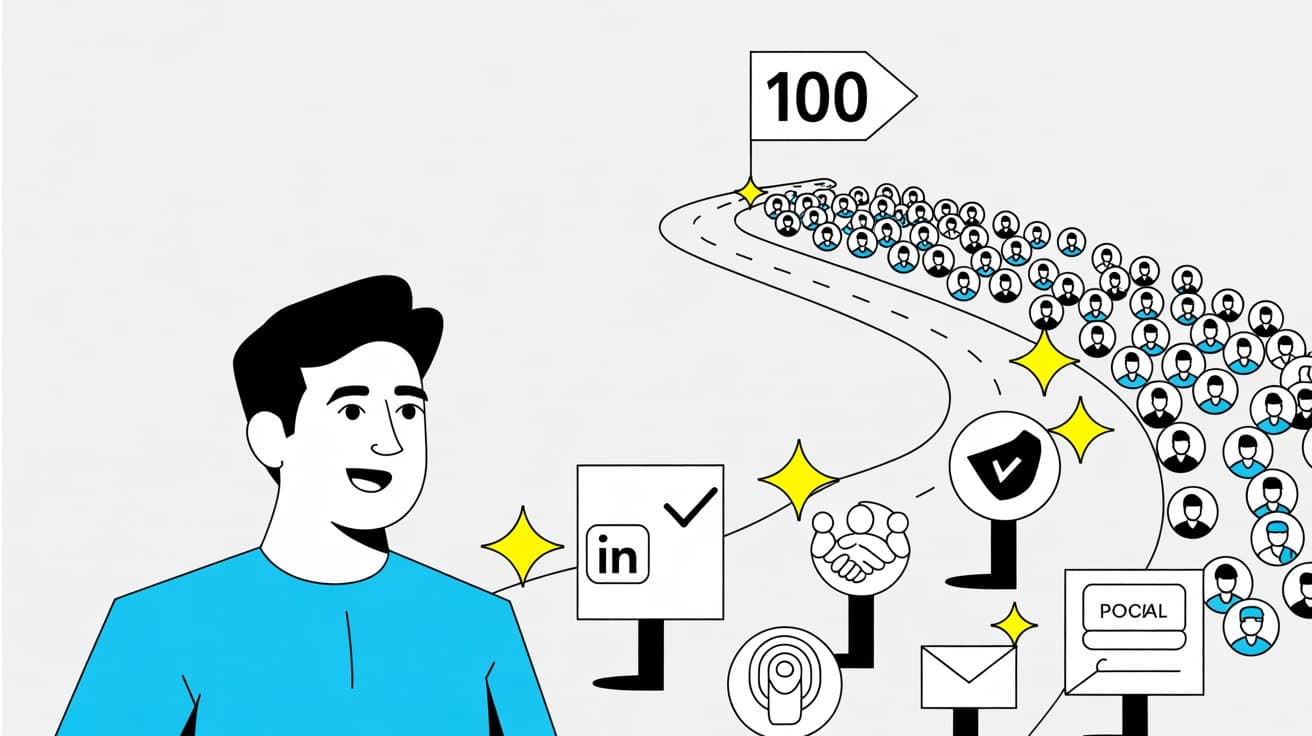
The founders who hit 100 paying users fastest have their distribution plan baked into the MVP itself. Their landing page, onboarding, share mechanics, and pricing model are designed to support a specific go-to-market motion — not retrofitted afterwards.
If your first 50 users are coming from your personal network and outbound, your MVP needs an extremely smooth manual onboarding flow. If they're coming from SEO, you need landing pages and content baked into the launch. If they're coming from a community you're already part of, your sharing and referral mechanics need to be tight from day one.
We've written a full breakdown of how to actually get your first 100 B2B users without paid ads — worth reading before you finalize your MVP scope, because your distribution plan should shape what you build.
QUESTION 7
"What does success look like 90 days after launch?"
This is where we separate MVPs designed for learning from MVPs designed for vanity.
"10,000 signups" is a vanity goal. "100 users who use the core feature 3+ times in their first week and convert to paid" is a learning goal. The difference matters because it shapes what you measure, what you build into the product, and what you do after launch.
The strongest founders we work with come in with a clear answer to this question: a specific number of paying users, a specific retention threshold, a specific revenue target — and a clear plan for what they'll do based on whether they hit it.
Even better: they've defined what they'll change based on what they learn. "If our trial-to-paid conversion is below 8%, we'll rework onboarding. If it's above 15%, we'll double down on acquisition."
What We Do With the Answers
These aren't trick questions. They're the inputs that determine whether we can scope a 10-week MVP at ₹15 lakhs or whether the project actually needs 24 weeks at ₹40 lakhs — and whether we should take it on at all.
If a founder can answer 6 of the 7 with confidence and specificity, we can usually scope a tight, focused MVP that ships in 8–12 weeks and gives them real data within a quarter.
If they can only answer 2–3, we typically recommend they spend another 2–4 weeks doing customer discovery before committing to a build. That uncomfortable conversation has saved more than one founder from spending ₹25 lakhs on a product nobody wanted.
The Cost of Skipping This
We've watched founders skip this scoping work because they were in a hurry. Almost without exception, they paid for it later — in scope creep, in mid-project rebuilds, in launches that landed flat because the product was solving the wrong problem.
Two weeks of rigorous scoping at the start saves 8–12 weeks of rework in the middle. The math is brutal but consistent.
What We Recommend
Before you sign with any agency or hire any developers, sit with these 7 questions. Write your answers down. Show them to 3 people who'll push back honestly. If you can defend your answers under pressure, you're ready to build. And once your scope is locked, the next question is distribution — here's our playbook for the first 100 paying users, which we recommend reading before you start building.
If you can't, keep working on the scope before you spend on the build. It's the highest-leverage time you'll spend on the project, and it's almost always free.
We help founders work through these questions in a structured discovery process before any quoting begins — because we'd rather lose a project upfront than ship one that fails. If you want a second pair of eyes on your scope before you commit to a build, talk to us. We'll tell you honestly whether you're ready to ship or whether you need another two weeks of thinking first.