If you've started researching what it costs to build a marketplace app in India, you've probably received quotes ranging from ₹3 lakhs to ₹60 lakhs for what sounds like the same product. That spread isn't random — it reflects genuine differences in what each agency is actually building. This post breaks down what drives marketplace cost, what you should realistically budget, and what most founders get wrong the first time.
Why Marketplace Quotes Vary So Much
A "marketplace app" means different things to different agencies. One agency's quote includes a buyer app, seller app, admin dashboard, payment integration, notification system, and production deployment. Another's includes two screens and a database. Both call it a marketplace MVP.
Before you compare quotes, get every agency to define what's included. The checklist below is what a real marketplace MVP requires — use it to evaluate every quote you receive.
What a Real Marketplace MVP Includes
A production-ready marketplace is not one product — it's three, built simultaneously and integrated:
- Buyer side: Browse/search, listing detail, booking or purchase flow, order tracking, reviews
- Seller side: Onboarding and verification, listing creation and management, order management, payouts
- Admin panel: User management, listing moderation, dispute resolution, analytics, manual overrides
- Payments: Razorpay or Stripe integration, escrow logic (for service marketplaces), refund handling, payout scheduling
- Notifications: Push, SMS, and email for key events on both sides
- Production deployment: Hosting, monitoring, staging environment, CI/CD pipeline
If a quote doesn't include all of these, ask what's missing and what it would cost to add it. The "extras" are almost always the most important parts.
The Real Cost Breakdown in 2026
Based on marketplace builds we've done for founders across India, UAE, and Canada, here's what you should actually expect to pay:
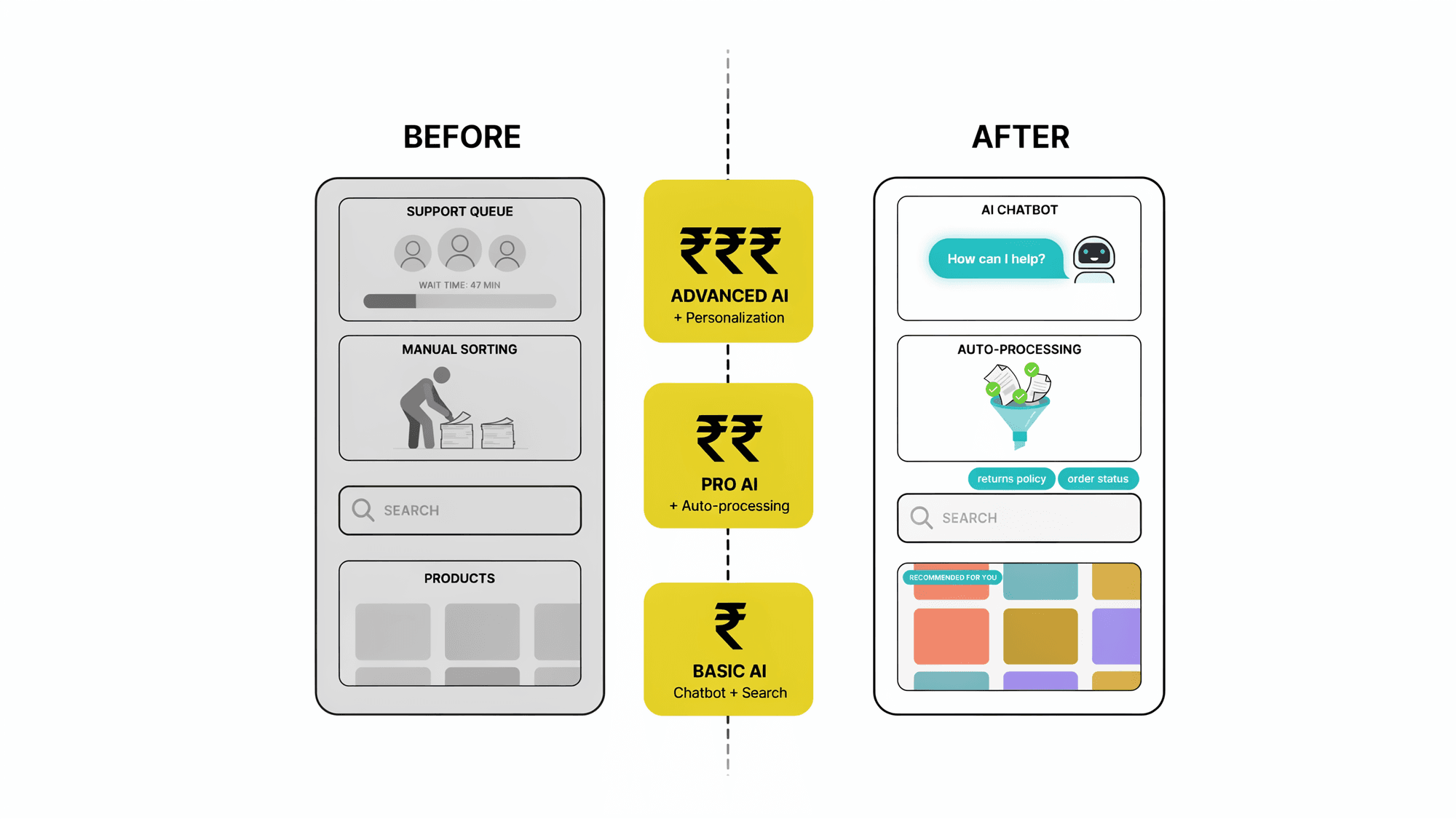
Tier 1: Lean Marketplace MVP — ₹10–18 lakhs
Timeline: 10–14 weeks
A focused two-sided marketplace doing one category well. Single geography, limited seller types, straightforward transaction flow. Think: a local services marketplace, a niche B2B sourcing platform, or a single-category rental marketplace.
What you get: buyer app (mobile web or React Native), seller app, basic admin panel, Razorpay integration, email and SMS notifications, production deployment on a modern stack.
What's excluded: complex matching logic, multi-category support, verification workflows, escrow, native iOS + Android.
Tier 2: Standard Marketplace MVP — ₹18–35 lakhs
Timeline: 14–20 weeks
This is where most serious marketplace ideas land. Multiple user roles, real verification flows (documents, KYC, background checks), escrow or split-payment logic, a properly built admin panel with moderation tools, and infrastructure that handles real transaction volume.
What you get: everything in Tier 1, plus multi-role access, verification and onboarding flows, escrow and dispute logic, seller analytics, comprehensive admin tools, React Native mobile app (iOS + Android), structured analytics, load-tested infrastructure.
Tier 3: Complex Marketplace — ₹35–60 lakhs
Timeline: 20–28 weeks
Multi-category marketplaces, platforms with complex matching or recommendation logic, AI-powered features (smart pricing, fraud detection, demand forecasting), compliance requirements, or enterprise-grade multi-tenancy. Also applies if you need a native mobile app alongside a full web platform from day one.
The Three Things That Make Marketplaces Expensive
Founders consistently underestimate three areas that drive marketplace cost up:
1. The Admin Panel
Every marketplace needs a nerve centre — a place where you can see everything happening on both sides of the platform, moderate listings, manage disputes, process refunds, and override anything that goes wrong. A real admin panel is typically 20–25% of the total build cost.
Agencies that quote low often skimp here. You find out at launch when you have no way to manage your own platform without going into the database directly.
2. Payment and Escrow Logic
Simple payment integration (buyer pays, money goes to seller) is straightforward. Real marketplace payments are not. You need to hold funds until service delivery is confirmed, split payments between platform and seller, handle partial refunds, manage payouts on a schedule, and deal with disputes where money is already in the system.
This logic is genuinely complex to build correctly. Agencies that haven't done it before will underestimate it in their quote and overrun on delivery.
3. Dual-Sided Onboarding
A marketplace has two customers: buyers and sellers. Each needs a different onboarding flow, different verification requirements, different notifications, and different ongoing support. Everything you build for one side, you build a version of for the other. Founders often scope for one side and discover the second side doubles the product work.
What Most Founders Get Wrong
The single biggest mistake we see: founders build the buyer experience beautifully and treat the seller side as an afterthought. Sellers are your supply — without them, the marketplace doesn't function. A seller onboarding experience that's confusing or manual will limit your growth more than any marketing budget can fix.
The second biggest mistake: launching without an admin panel because "we'll build it later." You will need to manage your platform from day one — moderation, disputes, refunds, user management. Without an admin panel, every operational task becomes a database query. This is unsustainable and expensive to fix retrospectively.
Web App vs Mobile App: What to Build First
For Indian marketplaces in 2026, our recommendation for most categories:
- Start with React Native — one codebase, ships to iOS and Android simultaneously, significantly cheaper than two native apps
- Buyer side on mobile, seller side on web — buyers browse on their phones; sellers (especially B2B sellers) often prefer a desktop interface for managing inventory and orders
- Don't build native iOS + Android separately in v1 — adds 40–60% to build cost with minimal user-facing benefit at MVP stage
How to Get an Honest Quote
When you're evaluating agencies, these questions separate the serious ones from the ones who'll scope low and bill high:
- "Does this quote include both buyer and seller apps, and a full admin panel?" — Get it in writing.
- "Have you built a marketplace with escrow or split payments before?" — Ask to see it.
- "What does post-launch support look like and what does it cost?" — Critical, almost never discussed upfront.
- "What's your process when scope changes mid-project?" — Every project has scope changes. Know how they handle it before you sign.
- "Can I speak to a founder whose marketplace you built?" — If they hesitate, that's your answer.
What to Budget in Total
A realistic total budget for a marketplace launch isn't just the build cost. It's:
- Build cost: ₹10–35 lakhs depending on tier
- Post-launch iteration (first 6 months): 20–25% of build cost
- Infrastructure and tools: ₹15k–50k per month depending on scale
- Early growth and supply acquisition: Budget separately — this is often bigger than the tech
The founders who succeed with marketplace builds aren't the ones who spent the least on the build. They're the ones who budgeted for the full journey — build, iterate, grow — not just the launch.
What We Recommend
If you're scoping a marketplace, define your single most important transaction first. What's the one exchange of value — between which two types of users, in which category — that your platform exists to facilitate? Build that transaction end-to-end and exceptionally well before you add categories, geographies, or features.
The marketplaces that scale are the ones that got one thing working perfectly, then expanded. The ones that fail try to be everything at launch and execute nothing well.
We've built multi-role marketplaces for agri supply chains, creator platforms, and B2B sourcing — and we scope every one of them starting from the core transaction, not the feature list. If you're planning a marketplace build and want an honest scope and budget estimate, talk to us. We'll tell you exactly what tier your idea falls into and what it should cost — even if that means telling you to start smaller than you planned.